

We had wanted to visit Kettle's Yard for a long time and finally made the trip last weekend. It absolutely didn't disappoint, and before we'd even left we were already talking about when we could return.
Walking through the house, we couldn't help but think of Finn Juhl's house at Ordrupgaard. There is a similar feeling throughout the interiors; calm, thoughtful and deeply personal. Rather than feeling like a museum, Kettle's Yard feels like a home that has evolved naturally over time. Every room encourages you to slow down, notice the details and appreciate how furniture, art and everyday objects can exist together.
What we loved most was seeing paintings, sculptures and artworks displayed in a domestic setting rather than on gallery walls. It feels completely different. The collection becomes part of everyday life, sitting alongside furniture, ceramics, glass and natural objects in a way that feels effortless.
One of the things that stayed with us after our visit was the reminder that creating a beautiful home doesn't happen overnight. It is built over a lifetime. Timeless furniture sits comfortably alongside objects collected on travels, artwork discovered over the years and pieces that carry memories. The result is a home that is distinctive because it reflects the people who live there.
That philosophy feels just as relevant today. Rather than following trends, invest in pieces you truly love, furniture that will stay with you for decades and become part of your own story.
Visitors are encouraged to sit in the chairs throughout the house and experience the rooms as Jim and Helen Ede intended. The artworks have been carefully positioned so they can be appreciated from a seated position, making you pause rather than simply walk past.
The interiors are also wonderfully composed through colour. In the cottage living area, for example, the blue within a Joan Miró painting quietly echoes subtle blue tones elsewhere in the room, creating connections between artworks, furniture and objects without ever feeling contrived.
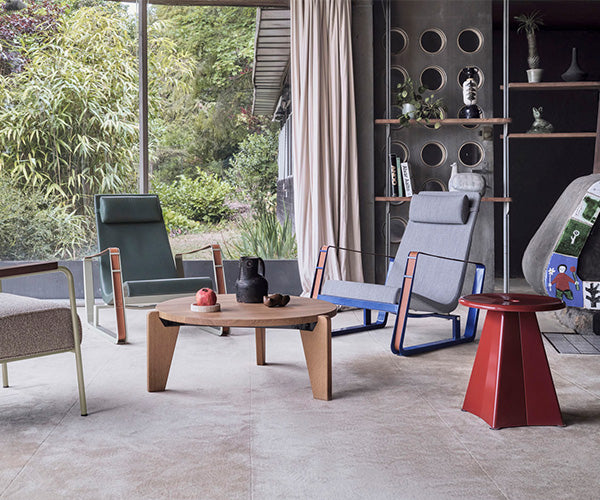
We have put together an edit of furniture, lighting and accessories inspired by our visit to help create some of that same feeling at home, the Kettles Yard edit. Not to recreate Kettle's Yard, because that would be impossible, but to embrace the idea of living with well-made furniture, meaningful objects and collections that evolve naturally over time.
 photo paul attrich
 photo paul attrich
The History of Kettle's Yard
Kettle's Yard began with a simple but remarkable idea. In 1956, Jim and Helen Ede arrived in Cambridge looking for what Jim described as a "stately home". Instead, they discovered four run-down cottages beneath the ancient Church of St Peter. Working with architect Rowland de Winton Aldridge, they carefully restored and transformed the buildings into the house we know today.
The house became much more than somewhere to display an impressive art collection. Jim carefully positioned paintings, sculpture, furniture, ceramics, glass and natural objects to create what he described as a harmonious whole. His intention was never to create a conventional museum or gallery, but a living environment where art became part of everyday life.
Jim described his vision as:
"An art gallery or museum, nor … simply a collection of works of art reflecting my taste or the taste of a given period. It is, rather, a continuing way of life..."
That philosophy is evident throughout the house today. There are no labels beside the artworks, allowing visitors to experience the spaces naturally rather than being directed from object to object.
In 1966 Jim and Helen gave Kettle's Yard and its contents to the University of Cambridge. Before retiring to Edinburgh in 1973, an extension and exhibition gallery were added, while the original house has remained remarkably faithful to the way they left it.

photo paul attrich
Jim and Helen Ede
Jim Ede often described himself as a "friend of artists", and it was these friendships that shaped the collection. During his years at the Tate Gallery in London he became close to artists including Ben Nicholson, Winifred Nicholson, Christopher Wood and David Jones. Visits to Paris introduced him to Pablo Picasso, Marc Chagall, Joan Miró and Constantin Brancusi, while his support for Henri Gaudier-Brzeska and Alfred Wallis helped preserve and promote their work.
Although Jim is often associated with Kettle's Yard, Helen's contribution was equally important. An artist herself, she brought warmth, hospitality and music to the house. Her Bechstein piano became part of daily life, with music by Schubert, Beethoven and J.S. Bach frequently filling the rooms. Together they created a home where visitors were welcomed, conversations were encouraged and art was simply part of everyday living.
 photo paul attrich
More Than a House
Perhaps what makes Kettle's Yard so memorable isn't simply the collection itself, but the feeling it leaves you with.
The furniture isn't there to impress. The artwork isn't arranged to overwhelm. Everything has been thoughtfully placed to create balance, comfort and harmony. You quickly realise that every chair, every ceramic, every pebble and every painting has a relationship with the objects around it.
It reminds us that the best interiors are rarely finished. They develop slowly through careful choices, meaningful purchases and objects collected throughout life.
As lovers of modern furniture and timeless design, that felt like perhaps the biggest lesson from our visit. Buy well. Buy pieces you'll want to live with for decades. Let your home evolve naturally around them.
That, more than anything, feels like the enduring legacy of Kettle's Yard.
Discover our Kettles yard inspiration edit.

photo hufton + crow

photo paul allitt


 photo jasper fry